
GLOBAL OIL SUPPLY COULD DWINDLE
Strait of Hormuz disruptions will test the world's reserves
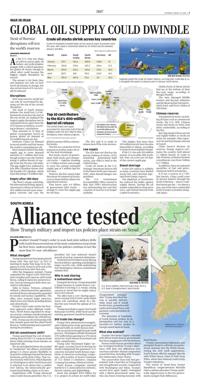
Tugboats guide the crude oil tanker Odessa, carrying UAE crude May 8, as it navigates the waters at Daesan port in Seosan, South Korea.
WAR IN IRAN
As the U.S.-Iran war drags on with no end in sight, oil traders and policymakers grapple with a critical question: are global oil stocks enough to offset what could become the biggest supply disruption on record?
The answer is far from clear and depends not only on how much oil remains in storage, but also on how much of it can actually be released.
Disruptions
How long reserves would last can only be ascertained by figuring out the size of the current disruption.
The head of Saudi Aramco believes the world lost 2.6 billion barrels of oil since the start of the war on Feb. 28, making it the largest supply disruption ever in cumulative terms apart from the 1979 Iranian revolution, according to Reuters' calculations.
That amounts to 25 days of global consumption based on prewar global oil demand of 103 million barrels per day.
However, China cut demand in recent months and that means the world is consuming less oil.
Most analysts believe the daily supply gap to cover demand amounts to 5 million bpd even though Aramco says the world is losing 11 million barrels of supply from the Persian Gulf daily. The gap might have widened in July after Ukrainian drones shut the Kazakh CPC pipeline, which typically pumps 1.8 million bpd.
Empty after 180 days
The West's energy watchdog, the International Energy Agency, announced a release in March of 400 million barrels from emergency reserves and says the global economy still has substantial stocks.
The IEA was created in 1974 in response to another major oil crisis: the Arab oil embargo.
IEA stocks consist of government-held stocks and commercial stocks 鈥� together standing at 1.5 billion barrels and enough to cover the current estimated supply gap of 5 million bpd for 300 days.
However, the IEA cannot order the release of commercial stocks, such as those held by refiners for operational reasons.
That leaves only 0.9 billion in government-held stocks 鈥� enough to cover the supply gap for 180 days.
The IEA said it is ready to release more if the crisis worsens.
Low supply
The IEA does not disclose the precise makeup of stocks. Of its remaining government-held stocks, one-third is held in the United States.
Crude oil stocks in the U.S. Strategic Petroleum Reserve fell to the lowest levels since January 1983, when Ronald Reagan was president.
The U.S. Government Accountability Office warned in May that SPR's infrastructure was deteriorating fast and that a quarter of reserves is no longer available.
This implies that more than 100 million barrels have become impossible to release, according to analysts from Rapidan Energy.
If the U.S. has only 200 million barrels of accessible SPR stocks left, they can cover just 40 days of the current supply gap.
Diesel shortage
A new IEA release is unlikely as many countries have limited stocks left, said Christian Egeland from Energy Aspects.
The depletion of inventories has reduced the buffer against supply shocks, leaving the oil market vulnerable to sharp price rises, said Hamad Hussain from Capital Economics.
Global stocks of diesel and jet fuel are at the bottom of their five-year range, according to Morgan Stanley.
The wars damaged Middle Eastern and Russian refineries and hit diesel and jet fuel particularly hard, said Survo Sarkar of DBS Bank.
Chinese reserves
Total global oil stocks, including all types such as commercial stocks, the U.S. SPR, Chinese stocks and stocks on water, look fairly comfortable, according to the IEA.
But a big chunk of those are not real supply buffers as stocks on water, for example, often represent oil and fuel already sold and in transit.
China doesn't disclose its reserves. Energy Aspects estimates the country held almost 1.7 billion barrels of crude in July. However, estimates between consultancies vary from 1 billion to 1.7 billion.
In addition, there are unknown quantities of fuel and petrochemicals held in inventories.
If it has a reserve of 1.7 billion barrels, China could cover its prewar imports through the Strait of Hormuz 鈥� about 5.5 million barrels per day 鈥� for almost a year, one of the most comfortable levels in major economies alongside Japan.